
How Fractional CFOs Scale Without Hiring: One Client "Running Like Clockwork" at a Time

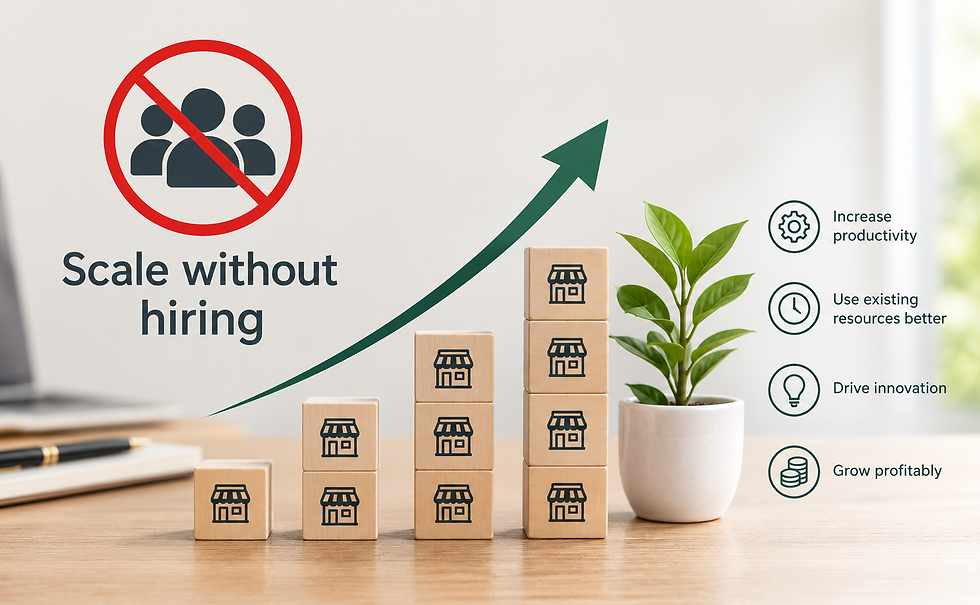
Ask most fractional CFOs and FDs how they'd grow their practice, and the answer usually involves hiring. Bring on an associate, take more clients, build a small team underneath you. It's the standard scaling model, borrowed more or less directly from how accounting firms and agencies have always grown.
It's also not the only model, and for a lot of fractional finance professionals, it's not even the right one. There's a quieter, less-discussed alternative: scale the number of clients you can properly serve, not by adding people, but by systemising each client until they need almost nothing from you, then using the capacity that frees up to take on the next one.
The one-client-at-a-time model
The logic is straightforward once you see it. A new client is expensive in attention. Processes are undocumented, historical data is messy, nobody's quite sure which reports actually get used, and month-end involves more firefighting than final review. That client takes real time.
But that state isn't permanent, and it isn't supposed to be. The work of the first few months with a new client is specifically about getting them to a settled, predictable state, what one experienced practitioner described as getting a business "running like clockwork." Once a client reaches that point, the ongoing time commitment drops sharply, not because the client got smaller, but because the client got organised.
That's the capacity a one-client-at-a-time model is built to release. Instead of a practice that grows linearly with headcount, where two associates roughly means twice the client capacity at twice the cost, a fractional professional running this model grows their client count as each existing client becomes lighter to run, funded entirely by systemisation rather than by adding salaries.
Why this isn't just "doing less"
It's worth being clear about what this model doesn't mean. It doesn't mean cutting corners on newer clients or providing a worse service once a client feels "sorted." It means the type of work changes. Early on, a fractional CFO is doing diagnostic and process work: finding what's broken, building the reporting cadence, deciding how recurring adjustments get handled, training whoever does the day-to-day bookkeeping on the new way of working. Later, once that's embedded, the fractional CFO's role shifts to oversight, reviewing rather than doing, stepping in only where genuine judgement is needed.
This is also, deliberately, a capacity model rather than a growth-at-all-costs model. Plenty of practitioners running this way choose to cap the total number of clients they'll take on, not because they've hit a ceiling, but because part of the appeal of fractional work in the first place was escaping the always-on demands of a full-time senior finance role. Scaling without hiring doesn't have to mean scaling without limit. It just means the limit is a deliberate choice, not an accident of how much administrative noise each client generates.
What "running like clockwork" actually looks like
This phrase is doing real work, so it's worth being specific about what it means in practice, rather than treating it as a vibe. A client that's genuinely running like clockwork tends to have a few concrete things true of it:
Recurring adjustments are systemised, not remembered. Prepayments, accruals, and deferred revenue don't rely on someone recalling that a particular supplier bills quarterly, or noticing a subscription renewal buried in a bank feed. There's a system tracking what's expected and flagging what's missing.
Junior staff can execute the routine work. The client's bookkeeper or accounts assistant can handle day-to-day processing without needing to understand the accounting theory behind it, because the judgement has already been built into the process, not left to be re-applied every month.
Reporting has a fixed, predictable cadence. Whether it's a weekly sales report or a monthly board pack, it exists on a schedule the client can rely on, rather than depending on the fractional CFO finding time for it.
Month-end is a review, not an investigation. The numbers are largely right by the time the period closes. What's left is confirming everything ties out and looking for genuine anomalies, not hunting down what's missing.
The fractional CFO's time is spent on judgement, not maintenance. Once a client hits this state, the questions coming to the fractional CFO are strategic, not administrative. That shift is the actual signal that a client is ready to need less time, freeing capacity for the next one.
A framework for assessing where a client actually stands
Before assuming a client is ready to move to "maintenance mode," it's worth checking against something more concrete than a feeling:
Can someone other than you close the books without you? If month-end still depends on your personal knowledge of what's owed and what's been missed, the client isn't there yet.
Are recurring costs and income tracked systematically, or held in your head? If the answer relies on your memory of which suppliers bill in advance or which contracts renew when, that's unfinished systemisation, not an efficient shortcut.
Has the reporting cadence survived a period where you were unavailable? A genuinely embedded process keeps running when you're away. If reporting slips the moment you step back, the client is still dependent on you personally.
Is your time on this client now spent answering questions, or still spent producing numbers? The transition from producing to advising is the clearest single signal that a client has reached clockwork status.
A client that fails most of these checks isn't a bad client, it's simply still in the build phase, and that's fine, as long as it's recognised honestly rather than assumed complete because enough months have gone by.
A worked example
Take a fractional finance professional running a portfolio of client businesses, an accommodation business here, a training and activity provider there. Each client arrives with a similar pattern: income received well in advance of when it's earned, spread across several different revenue streams and booking systems, held together by manual spreadsheets recalculated every month.
The first few months with a new client in this position are genuinely intensive. Recurring costs need identifying and systemising so nothing gets missed. Income received in advance needs a proper release schedule instead of a manual recalculation. Reporting expectations, weekly for one part of the business, monthly for another, need establishing and then automating wherever possible.
By month four or five, the pattern usually looks very different. The bookkeeper is handling routine processing directly, because the system tells them what's expected rather than requiring them to know. The fractional CFO's involvement drops to a periodic review and answering the genuinely strategic questions that come up, like how to handle a new revenue stream the business hasn't dealt with before. That drop in required attention is exactly the capacity that gets reinvested in the next client, rather than in hiring someone to help manage this one.
The trade-off worth naming honestly
This model isn't free of downsides, and it's worth being honest about the two real ones. First, it's slower to scale in the short term than hiring, since capacity comes from systemisation taking hold, not from adding a person on day one. Second, it depends on the fractional CFO actually being disciplined about moving clients to maintenance mode, rather than staying pulled into operational detail because it's familiar and comfortable. Practitioners who struggle to hand off routine work, even after building the system to do it, don't get the capacity benefit no matter how good the systemisation is.
Set against that, the model has a genuine advantage the hiring approach doesn't: it scales client capacity without scaling overhead, management responsibility, or the risk of carrying salaried staff through a quiet period. For a fractional professional who values the autonomy that drew them to the work in the first place, that trade-off is often the right one.
Frequently asked questions
How many clients can a fractional CFO realistically manage using this model? There's no fixed number, it depends heavily on client complexity and how thoroughly each one has been systemised. What matters more than the raw count is whether newer, less-systemised clients are properly resourced with attention while older ones run on lighter oversight.
Does this model work for a fractional CFO just starting out? Yes, though the early stage looks different. With no existing "clockwork" clients yet to lean on for capacity, growth in the first year or two typically comes from taking on clients one at a time and being deliberate about not overcommitting until each one is properly settled.
What's the biggest mistake fractional CFOs make trying to scale this way? Taking on a new client before the previous one has genuinely reached maintenance mode, based on how much time has passed rather than whether the actual signals, like being able to step away without reporting slipping, are true yet.
Is hiring ever the right move under this model? Yes, typically once systemisation itself becomes the bottleneck rather than ongoing oversight, for example if there are more new clients needing the intensive early-stage work than one person can handle at once. The two approaches aren't mutually exclusive, they solve different capacity problems.
What role does automation play in reaching "clockwork" status? A significant one, particularly for recurring, judgement-light tasks like accruals, prepayments, and deferred revenue tracking. These are exactly the tasks that used to require the fractional CFO's personal attention every month, and are now the easiest to hand fully to a junior bookkeeper once a proper system is tracking what's expected.
The bottom line
Scaling a fractional CFO practice doesn't have to mean scaling headcount. Getting one client running like clockwork, genuinely running without your constant attention, then moving to the next, is a legitimate growth model in its own right, not a smaller, slower substitute for hiring. The constraint worth managing isn't how many clients you can theoretically hold, it's being honest about which ones have actually reached maintenance mode and which ones are still pretending to have, because that's the difference between real capacity and a portfolio quietly running on borrowed attention.
Recurring accruals, prepayments, and deferred revenue are usually the first things worth systemising when moving a client toward clockwork status, since they're routine, repetitive, and don't need to depend on anyone's memory. Spread is built for exactly that layer, worth a look if that's the piece still eating your time across your client book.


Comments